
C-Myc Tag Peptide: An Essential Tool for Protein Research, Purification, and Therapeutic Development
Introduction to C-Myc Tag Peptide
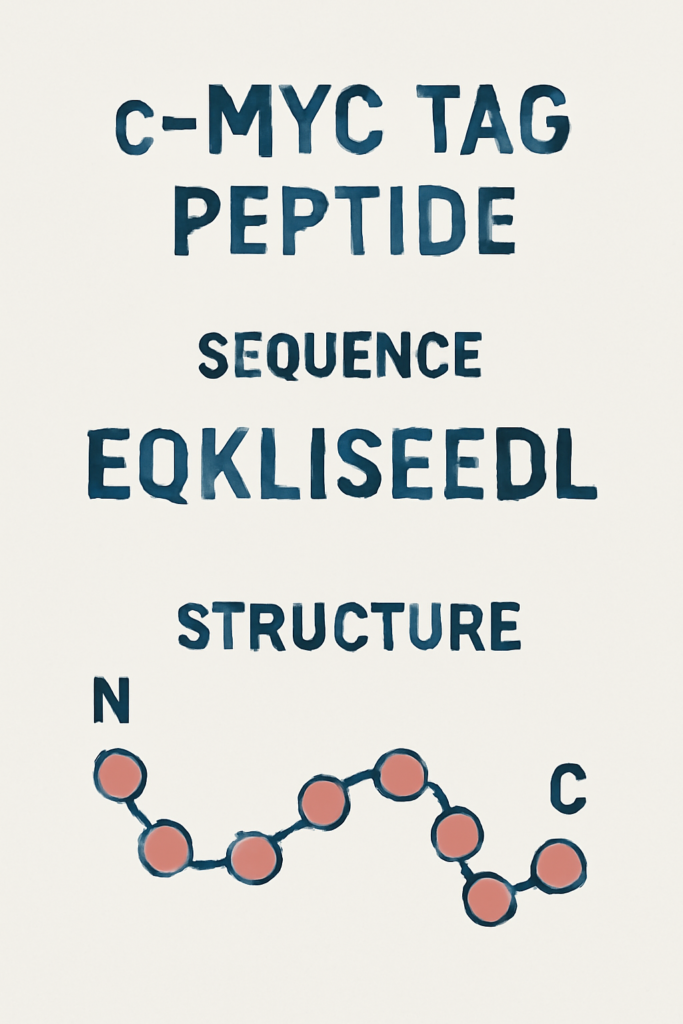
The C-Myc tag peptide is a widely used epitope tag that facilitates the detection, purification, and study of proteins in biological research. Derived from the c-Myc oncogene, which encodes a transcription factor involved in cell growth, differentiation, and apoptosis, the C-Myc tag is a short peptide consisting of just ten amino acids (EQKLISEEDL). Despite its small size, this peptide plays an outsized role in molecular biology, biotechnology, and medical research.
The C-Myc peptide tag enables the straightforward detection of recombinant proteins in complex biological samples, making it an indispensable tool for researchers working in various fields, including cancer research, immunology, and proteomics. Because the C-Myc tag is universally recognized by a specific antibody, it provides a reliable and versatile method for tracking proteins in cells, tissues, and tissues over time.

What is the C-Myc Tag Peptide and Why is it Used?
The C-Myc tag is derived from the c-Myc protein, a member of the Myc family of transcription factors that regulate cellular proliferation, differentiation, and apoptosis. While c-Myc itself is involved in many cell cycle pathways and is often implicated in various cancers, its tag is utilized specifically in protein research due to its small size, which minimizes the potential for altering the protein’s native function.
Fusing the C-Myc tag to a recombinant protein enables easy tracking and purification of the protein of interest. It also ensures high specificity during detection processes, as the anti-c-Myc antibody binds only to the C-Myc tag, making it an essential tool for protein assays and structural studies.
Key Benefits of the C-Myc Tag Peptide
1. Efficient Protein Expression and Purification
The most well-established use of the C-Myc tag peptide is in protein expression systems, where it enables efficient recombinant protein production in various host systems, including E. coli, yeast, mammalian cells, and insect cells. Once fused to the target protein, the C-Myc tag can be recognized by an anti-c-Myc antibody, which allows researchers to purify the tagged protein using affinity chromatography.
This purification process is extremely useful in isolating proteins from cell lysates, providing researchers with high-purity samples for further analysis. Importantly, the small size of the tag reduces the likelihood of interference with the protein’s structure and function, which is a key consideration in ensuring that the protein behaves similarly to its untagged form.
2. Simplified Detection Methods
The C-Myc tag is a powerful tool for protein detection. Due to the widespread availability of anti-c-Myc antibodies, it is one of the most commonly used epitope tags for identifying recombinant proteins in Western blotting, immunofluorescence microscopy, flow cytometry, and immunohistochemistry.
Researchers can quickly detect proteins tagged with C-Myc using standard lab procedures without the need for complex detection systems. This is a major advantage in high-throughput experiments and protein screening, as it simplifies the analysis of protein expression levels in various experimental conditions.
3. Facilitating Protein-Protein Interaction Studies
The C-Myc tag is also an invaluable tool in studying protein-protein interactions. One of the most common applications is in co-immunoprecipitation (Co-IP) assays, where researchers can isolate a protein complex containing the C-Myc-tagged protein by using antibodies specific to the C-Myc tag.
This enables scientists to identify interaction partners of a specific protein of interest, which is crucial for understanding cell signaling, protein networks, and disease mechanisms. This technique is particularly important for the study of proteins involved in transcriptional regulation, signal transduction, and post-translational modifications.
4. Monitoring Cancer Research and Myc Oncogene Studies
The c-Myc gene is one of the most important oncogenes, frequently overexpressed in a variety of cancers, including lymphomas, leukemias, and solid tumors. The C-Myc tag peptide plays a critical role in cancer research by helping scientists study the Myc pathway in cancer cells.
Researchers use C-Myc-tagged proteins to investigate how Myc-regulated proteins contribute to tumorigenesis, cell proliferation, and metastasis. These studies help identify potential drug targets and biomarkers for early cancer detection and therapeutic intervention.
Moreover, the C-Myc tag allows for the quantification and localization of Myc-tagged proteins within tumors or during metastasis, providing essential insights into cancer progression and treatment resistance. This information is vital for developing targeted therapies aimed at inhibiting Myc activity in cancer cells.
5. Accelerating Vaccine and Immunotherapy Development
In the field of vaccine development, C-Myc tag peptides are used to express recombinant proteins, particularly antigenic proteins, which are then used to stimulate the immune system. These proteins are often tagged to facilitate their purification from expression systems.
In immunotherapy, C-Myc-tagged proteins are utilized to track immune responses and monitor the targeting of therapeutic immune checkpoint inhibitors. By tagging and tracking proteins involved in immune activation, researchers can gain deeper insights into the efficacy of immunotherapies, including those used for cancer treatment and infectious diseases.

Applications of the C-Myc Tag Peptide in Biotechnology and Beyond
1. Recombinant Enzyme Production
In the biotech industry, the C-Myc tag peptide is commonly used for the production of recombinant enzymes. Enzymes that are involved in industrial applications, such as bioremediation, biofuel production, and food processing, are often expressed and purified using C-Myc-tagged fusion proteins. The ability to easily purify these enzymes from complex mixtures makes the process more efficient and cost-effective.
2. Structural Biology and Protein Crystallization
The C-Myc tag has a significant impact on structural biology and protein crystallization efforts. Since the C-Myc tag peptide can be easily incorporated into proteins without disrupting their structure, it is often used to aid in the purification of proteins intended for X-ray crystallography, cryo-EM, or NMR spectroscopy.
By purifying proteins with the C-Myc tag, researchers can obtain high-quality samples for structural analysis. This is particularly valuable in membrane proteins or other difficult-to-crystallize proteins, where the C-Myc tag can provide stability without altering the protein’s functional properties.
3. High-Throughput Protein Screening
For drug discovery and protein engineering, the C-Myc tag peptide is frequently used in high-throughput screening (HTS) systems to detect and purify proteins involved in biological assays. Researchers can use the tag to isolate proteins from large libraries, facilitating the identification of small molecule inhibitors, protein modulators, or biomarkers relevant to diseases like cancer and neurodegeneration.
4. Functional Genomics and Gene Editing
In functional genomics, the C-Myc tag peptide is invaluable in CRISPR/Cas9 gene editing experiments. By tagging edited genes with a C-Myc tag, researchers can easily track gene expression and assess the success of knock-in or knockout experiments. This is essential for validating the efficiency of gene-editing techniques and understanding the functional consequences of genetic modifications.
Moreover, C-Myc-tagged proteins can be used to study gene regulatory networks and identify new transcriptional regulators involved in various diseases and conditions.
Recent Developments and Innovations in C-Myc Tag Technology
1. Improved Antibodies for C-Myc Detection
Recent advancements in antibody technology have improved the specificity and sensitivity of anti-C-Myc antibodies, allowing for faster and more accurate detection of C-Myc-tagged proteins. New antibody formats, such as nanobodies and single-domain antibodies, provide enhanced performance in applications such as in vivo imaging, immunoassays, and live-cell protein tracking.
2. Multi-Tag Systems
Researchers have developed multi-tag fusion systems where the C-Myc tag is used alongside other tags, such as His-tag or FLAG-tag, to improve the efficiency of protein purification and detection. These multi-tagging systems enable more flexible and robust experiments, especially when working with proteins that require stringent purification protocols or have low expression levels.
3. Next-Generation Applications in Synthetic Biology
In synthetic biology, the C-Myc tag peptide is being used to construct artificial gene networks and to engineer proteins with new functions. Its small size and efficiency make it an ideal tag for integrating into synthetic gene circuits and for enabling biosensors capable of detecting specific cellular signals or molecules.
Conclusion: The Future of C-Myc Tag Peptides in Biomedical and Biotech Research
The C-Myc tag peptide continues to be one of the most widely used and valuable tools in molecular biology, biotechnology, and biomedical research. Its versatility in protein expression, detection, and purification makes it indispensable in both basic and applied research.
As new technologies and techniques emerge, the C-Myc tag will remain crucial in driving advances in genomics, drug discovery, and therapeutic development. Researchers continue to explore innovative ways to use the C-Myc tag in high-throughput assays, gene editing, and synthetic biology, making it an essential tool in the life sciences.
For further information on the C-Myc tag peptide and its applications, explore these resources: