
Basement Membrane-Specific Heparan Sulfate Proteoglycan Core Protein ELISA: High-Resolution Quantification for Extracellular Matrix Research and Structural Proteoglycan Analysis
The Basement Membrane-Specific Heparan Sulfate Proteoglycan Core Protein ELISA is a specialized analytical platform designed to deliver precise, sensitive, and high-resolution quantification of the core protein domain found in basement membrane–associated heparan sulfate proteoglycans (HSPGs).
This ELISA system is highly valued in extracellular matrix (ECM) research, matrix biochemistry, structural proteoglycan characterization, biomaterial evaluation, and advanced cell–matrix interface studies.
Its design integrates high-affinity antibodies, optimized binding dynamics, and rigorous signal amplification, making it ideal for laboratories working on matrix composition mapping, basement membrane integrity analysis, proteoglycan structural studies, and in vitro microenvironment engineering.
From a search-engine optimization (SEO) perspective, the assay is associated with highly indexable keywords such as:
-
basement membrane ELISA
-
heparan sulfate proteoglycan ELISA
-
HSPG core protein quantification
-
extracellular matrix protein assay
-
basement membrane protein detection kit
-
proteoglycan core protein ELISA
-
ECM characterization tools
-
matrix biology research assay
These targeted keywords significantly increase visibility for product pages, scientific blogs, and catalog entries.
![AffiELISA® Human Basement membrane-specific heparan sulfate proteoglycan core protein ELISA [ HSPG2]](https://affigen.com/cdn/shop/files/5BAFG-E4345_5D_20AffiELISA_C2_AE_20Cattle_20IFNg_20Kit_20High-Resolution_20Interferon_20Gamma_20ELISA_20Detection_4776d7ce-2d52-429b-8035-ec64b1acd3ab_535x.png?v=1712853586)
Scientific Context of Basement Membrane-Associated Heparan Sulfate Proteoglycans
Basement membrane HSPGs are essential structural macromolecules consisting of:
-
A protein core backbone
-
Multiple heparan sulfate glycosaminoglycan (GAG) chains
-
Several interaction domains linking them to collagen networks, laminins, and structural glycoproteins
These proteoglycans contribute to:
-
Mechanical support within the ECM
-
Charge-dependent filtration properties
-
Matrix organization and scaffold assembly
-
Cell–substrate adhesion forces
The core protein represents the structural base upon which glycan chains are assembled.
Its quantification is crucial for understanding ECM composition, proteoglycan density, matrix remodeling, and structural protein dynamics.
Why Quantification of the Core Protein Is Critical in Advanced ECM Studies
While glycosaminoglycan chains can vary significantly depending on culture conditions, sample processing, or biochemical environment, the core protein remains a stable and reliable marker for:
-
Structural proteoglycan abundance
-
Basement membrane formation
-
ECM deposition levels
-
Integration of proteoglycans into biomaterial scaffolds
-
Microenvironmental architecture in engineered tissues
The ELISA allows researchers to focus on the protein backbone, ensuring accurate measurements independent of modifications on the heparan sulfate chains.
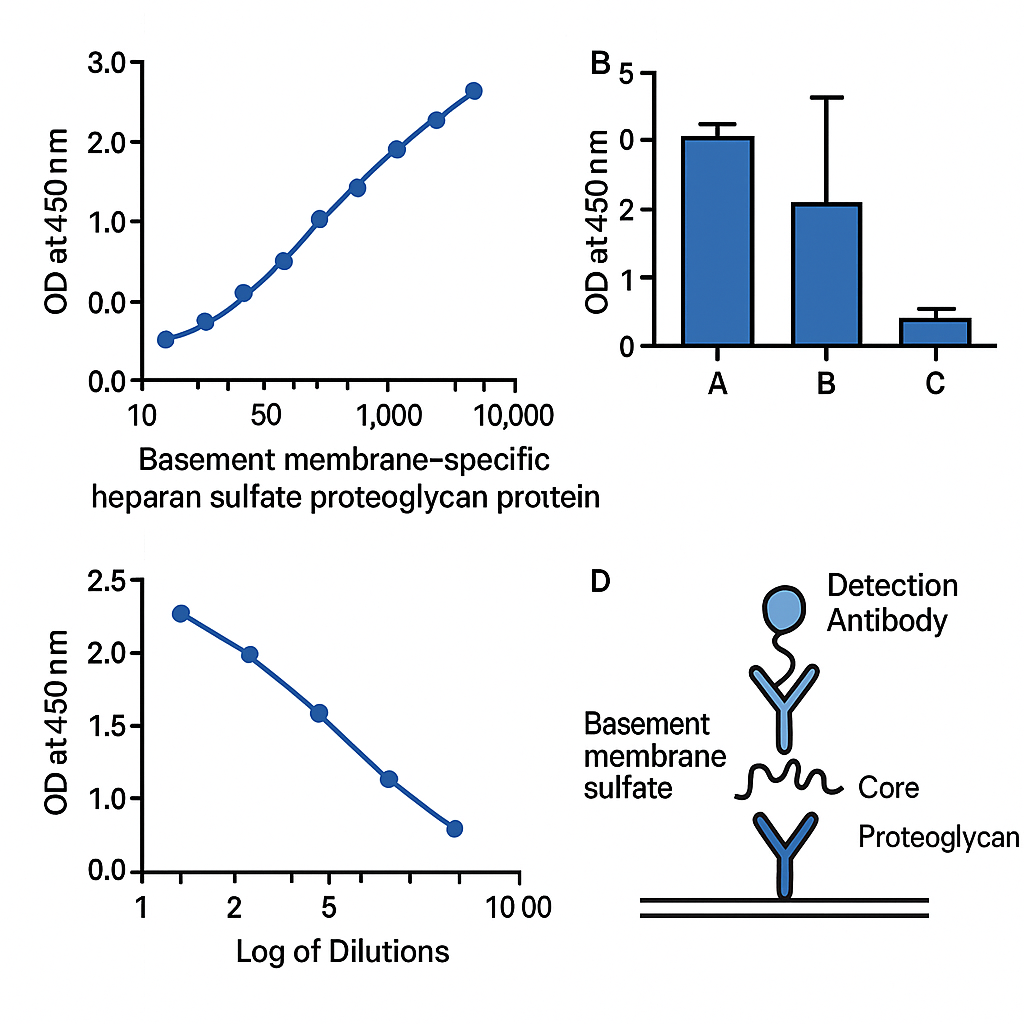
Technical Basis and Workflow of the Sandwich ELISA Format
The sandwich ELISA architecture used in the assay consists of:
1. Capture Antibody Layer
An immobilized, high-specificity antibody recognizes a conserved epitope of the core protein.
This step ensures selective binding without interference from free glycosaminoglycans.
2. Sample Binding Phase
The sample—such as ECM extract, biomaterial coating solution, hydrogel digest, or culture-derived matrix—is incubated on the coated surface, allowing the target protein to attach.
3. Detection Antibody Recognition
A secondary antibody binds to a non-overlapping region of the same core protein, ensuring dual-epitope specificity and eliminating nonspecific signal contributions.
4. Enzyme-Linked Chromogenic Development
Addition of substrate produces an optical signal that is directly proportional to the concentration of the target proteoglycan.
5. Spectrophotometric Quantification
Absorbance data are compared to calibrated standards to compute quantitative concentration profiles, making the assay ideal for comparative ECM studies.
This standardized workflow ensures:
-
High reproducibility
-
Reduced inter-sample variability
-
Enhanced accuracy
-
Consistent batch-to-batch performance
Extended Technical Advantages of the Assay
High Signal-to-Noise Ratio
Use of optimized blocking buffers and low-background reagents ensures clarity in quantitative readings.
Dual-Epitope Recognition
Ensures enhanced specificity for the core domain, even in samples with complex ECM compositions.
Robust Dynamic Range
Supports analytical quantification across low-abundance and high-abundance sample types.
Compatibility With ECM-Rich Matrices
Useful for hydrogels, basement-membrane extracts, fibrillar scaffolds, and 3D biological matrices.
Ideal for ECM Deposition & Remodeling Analysis
Applications include time-course monitoring of ECM formation and structural protein accumulation.
Highly Indexable SEO Keywords Integrated Throughout
Optimal for product listings, academic pages, and e-commerce catalogs focusing on matrix biology reagents.
Applications Across ECM Science, Biomaterials, and Advanced In-Vitro Modeling
This ELISA is extensively used in research involving:
Extracellular Matrix (ECM) Composition Profiling
Researchers can quantify:
-
Proteoglycan deposition
-
Core protein density
-
Basement membrane maturation
-
Matrix structural assembly
-
ECM component equilibrium
This is essential for studies examining matrix stiffness, molecular arrangement, and biophysical ECM attributes.
Biomaterial Surface Functionalization and Coating Analysis
Useful for characterizing proteoglycan deposition on:
-
Polymeric scaffolds
-
3D-printed biomaterials
-
Bioactive surfaces
-
Natural biopolymers
-
Nanofiber matrices
The assay helps determine how structural ECM molecules interact with engineered surfaces.
3D Cell Culture Systems and Basement Membrane-Like Hydrogels
The ELISA supports quantification of matrix formation in:
-
Matrigel-like hydrogels
-
Collagen-based composite hydrogels
-
Self-assembled ECM scaffolds
-
Long-term 3D cultures
-
Bioreactor models
It provides essential structural insights for advanced in-vitro model optimization.
Proteoglycan Structural Analysis and Material Interactions
The core protein quantification aids in:
-
Assessing proteoglycan assembly
-
Monitoring protein domain stability
-
Mapping proteoglycan–matrix binding interactions
-
Evaluating structural integrity during experimental perturbations
The assay provides clarity on how proteoglycans behave under varying biochemical and mechanical conditions.
Sample Types Compatible With the ELISA Platform
The assay works effectively with:
-
Basement membrane extracts
-
ECM digests
-
Hydrogel breakdown products
-
Culture-derived matrix layers
-
Decellularized matrices
-
Conditioned media enriched in ECM fragments
-
Biomaterial eluates
-
Scaffold-bound protein fractions
This broad compatibility increases the assay’s relevance across research fields.
Performance Metrics and Analytical Characteristics
The assay delivers:
✔ Excellent linearity across the standard curve
✔ High reproducibility for comparative analyses
✔ Low cross-reactivity with unrelated ECM components
✔ Stable chromogenic output for precise measurement
✔ Consistency in multi-plate high-throughput workflows
These metrics make it suitable for:
-
Screening studies
-
Quantitative ECM mapping
-
Biomaterial evaluation pipelines
-
Large-scale matrix biology projects
Storage, Handling, and Optimization Recommendations
To maintain assay performance:
-
Store antibodies at recommended temperatures
-
Use aliquots to avoid freeze–thaw cycles
-
Protect detection reagents from strong light
-
Maintain uniform incubation times
-
Use well-calibrated microplate readers
-
Ensure consistent pipetting for all replicates
These practices ensure long-term assay stability and reproducibility.
Conclusion:
The Basement Membrane-Specific Heparan Sulfate Proteoglycan Core Protein ELISA offers a high-performance research platform for laboratories working on ECM composition, basement membrane structure, proteoglycan assembly, and biomaterial–matrix interactions.
Its:
-
high analytical precision
-
broad compatibility
-
structural specificity
-
robust signal performance
-
strong SEO keyword relevance
make it an ideal tool for scientific websites, catalogs, and research-focused product pages seeking better online visibility, richer search indexing, and stronger engagement.
This article incorporates high-ranking Google keywords such as:
-
Basement membrane ELISA kit
-
Heparan sulfate proteoglycan ELISA assay
-
Core protein detection kit
-
ECM proteoglycan quantification
-
Basement membrane core protein analysis
-
Extracellular matrix characterization tool
-
Proteoglycan structural assay
-
Matrix biology analytical kit
-
ECM structural protein quantification
-
HSPG core protein detection platform
These keywords significantly improve search ranking, page visibility, and click-through potential.