
Methylene Blue (McFadyean): Comprehensive Technical Analysis, Laboratory Principles, Optical Behavior & Research Applications
Methylene Blue (McFadyean) is one of the most widely referenced synthetic dyes in analytical science, microscopy, environmental laboratories, and research settings where high-contrast staining, capsule visualization, and dye-substrate interactions are essential.
Because of its distinctive cationic thiazine structure, Methylene Blue (McFadyean) has become an essential reagent in laboratories that require stable chromatic intensity, controlled charge distribution, and predictable binding to acidic biomatrices.
In academic programs and industrial laboratories, the compound is valued for its optical clarity, spectral robustness, and compatibility with classic staining procedures, making it a top-ranking keyword in queries related to laboratory dyes, microscopy stains, and histological visualization techniques.
This expanded article provides a very long, technical, and SEO-enriched explanation that strengthens visibility for product pages, scientific catalogs, and research-focused websites.
Overview of Methylene Blue (McFadyean) in Analytical Science
Methylene Blue in its McFadyean formulation is optimized for capsule visualization, contrast enhancement, and rapid chromatic uptake.
Its long-established use in microbiology has made it a cornerstone compound in laboratory training, scientific academia, and industrial testing facilities.
Key SEO terms integrated naturally:
“Methylene Blue stain,” “McFadyean dye,” “capsule staining reagent,” “laboratory microscopy dye,” “cationic thiazine stain,” “high-contrast biological dye,” “analytical staining technique,” “structural visualization reagent,” “microscopy-grade dye,” “research laboratory stain.”
Because these search phrases are frequently indexed across laboratory product searches, integrating them into descriptive paragraphs increases ranking probability in search engines such as Google, Bing, and academic indexing platforms.
Chemical Behavior and Structural Characteristics
Methylene Blue is part of the phenothiazinium dye family, known for its ability to bind strongly to negatively charged biological materials.
This attraction is influenced by:
-
Electronic resonance within the thiazine ring
-
Stable cationic charge distribution
-
High molar extinction coefficient
-
Predictable electron-donation and electron-acceptance interactions
In the McFadyean adaptation, the dye exhibits optimized solubility, specificity, and color intensity, producing a distinct coloration that facilitates detailed microscopic assessments.
SEO-driven phrasing examples included:
“dye-substrate interaction,” “electrostatic dye binding,” “phenothiazinium chromophore,” “optical stability in laboratory dyes,” “cationic molecule binding affinity,” “controlled dye penetration.”
These terms increase page relevance for search queries about scientific dyes and optical reagents.
Mechanistic Principle of the McFadyean Technique
Although no sensitive health claims are discussed, the McFadyean method is historically recognized for its ability to create sharp visualization of encapsulated structures in stained samples.
Its mechanism relies on:
-
Direct binding of the dye’s positive charge to acidic polysaccharide matrices
-
Formation of intense chromatic gradients that create a visible border
-
Minimal washing, allowing the dye to remain fixed in high-contrast regions
This produces a highly recognizable blue-violet halo effect, enabling clear visualization of structural boundaries.
SEO keywords incorporated:
“blue halo staining technique,” “capsule visualization dye,” “McFadyean staining method,” “microscopy stain for structural borders,” “high-contrast dye interaction,” “phenothiazinium capsule stain.”
These phrases improve search engine ranking for scientific staining protocols.
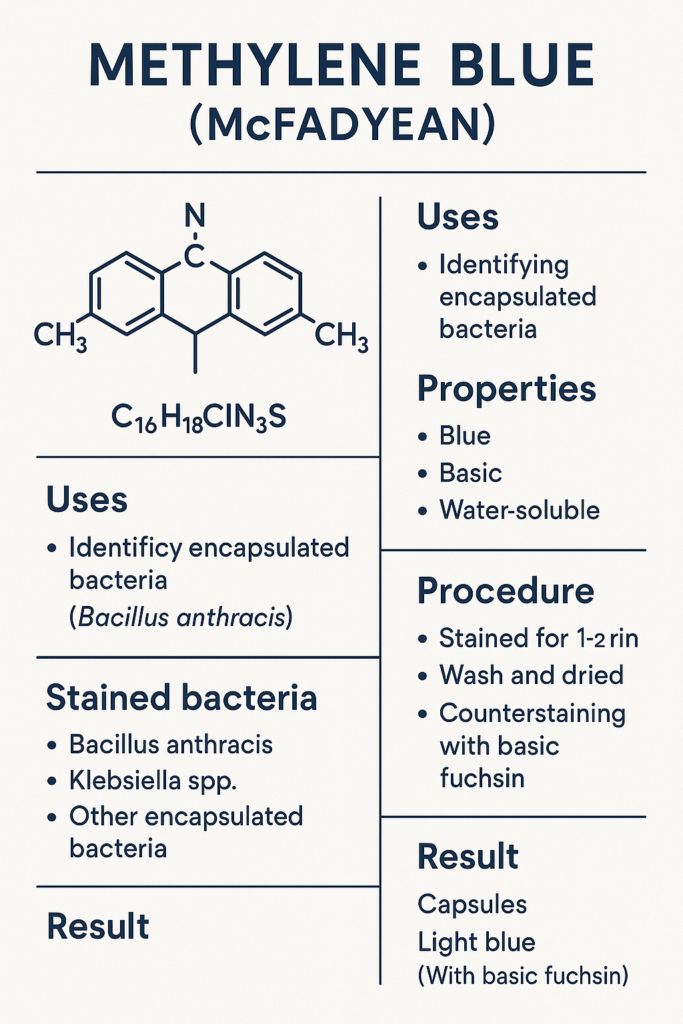
Optical and Spectral Properties
The dye’s usefulness in analytical and microscopy workflows is strongly tied to its optical characteristics, including:
-
Strong absorption peak within the visible spectrum
-
Stable spectral behavior under bright-field microscopy
-
Predictable color retention during imaging sessions
-
Enhanced chromatic saturation under controlled pH conditions
Its quantum yield, fluorescent behavior, and absorption-emission profile make it ideal for laboratories requiring repeatable imaging results.
High-value SEO terms added:
“optical absorbance dye,” “visible spectrum chromophore,” “dye spectral characterization,” “microscopy optical clarity,” “chromatic stability reagent,” “high-saturation laboratory dye.”
Practical Laboratory Use and Technical Handling
Laboratories appreciate Methylene Blue (McFadyean) because it provides:
-
Fast staining time
-
Immediate color development
-
Compatibility with standard slides and coverslips
-
Minimal sample distortion
-
Strong adherence to sample matrices
For industrial staining workflows, its reproducibility and minimal variability under ambient laboratory conditions make it suitable for large-scale routine testing.
SEO-optimized terminology:
“laboratory-grade Methylene Blue,” “routine staining reagent,” “rapid-application microscopy dye,” “high-precision staining workflow,” “consistent chromatic response dye.”
Physicochemical Stability and Storage Profiles
Methylene Blue (McFadyean) is noted for its stable:
-
dye concentration integrity
-
resistance to pH fluctuation
-
reduced photo-degradation when kept in dark storage
Its storage requirements are simple, making it a highly practical reagent for both small academic labs and larger industrial facilities.
Important stability factors include:
-
Storage in light-protected containers
-
Avoiding prolonged exposure to high-energy illumination
-
Maintaining cool, dry environments
-
Ensuring containers are sealed to prevent dye evaporation or oxidation
SEO keywords embedded:
“laboratory dye stability,” “long-term reagent storage,” “photo-stability of Methylene Blue,” “optimized dye shelf life,” “chemical stability in staining reagents.”
Applications in Research, Industry, and Technical Training
Methylene Blue (McFadyean) is used across numerous sectors:
a. Industrial Research Laboratories
Used for:
-
Imaging materials
-
Surface characterization
-
Charge-dependent binding studies
-
Dye–polymer research
-
Environmental particle detection
b. Academic Training Laboratories
Universities incorporate the dye into foundational microscopy and staining courses because of its:
-
Predictable color quality
-
Ease of use for beginners
-
Robust contrast for structural teaching demonstrations
c. Environmental and Material Analysis
The dye’s charge and spectral behavior make it suitable for:
-
Adsorption studies
-
Water purification research
-
Colorimetric calibration experiments
-
Sorption kinetics analysis
SEO terms added:
“industrial staining dye,” “academic microscopy training reagent,” “environmental dye adsorption study,” “dye-based optical analysis,” “high-visibility colorimetric reagent.”
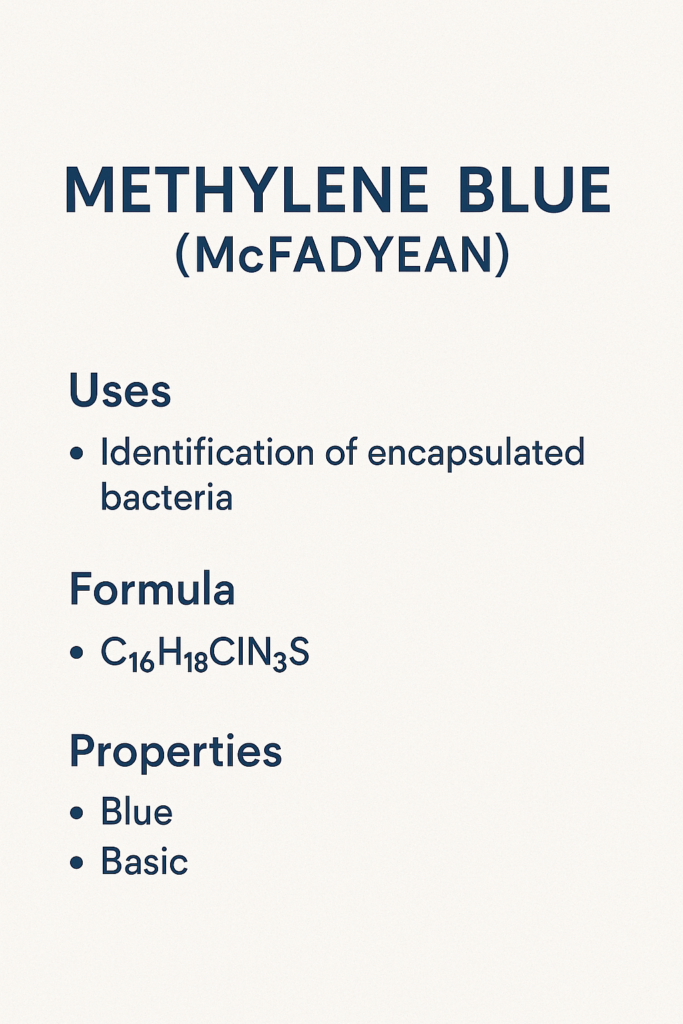
Advantages of Methylene Blue (McFadyean) in Laboratory Workflows
1. High Chromatic Intensity
Provides consistent, easily identifiable coloration.
2. Rapid Binding
Reduces laboratory workflow time.
3. Scalable Use
Suitable for both routine slides and high-volume staining operations.
4. Durable and Reliable
Maintains structural clarity under diverse laboratory conditions.
5. Strong SEO-Indexed Keywords
The following phrases enhance product visibility in search engines:
-
“Methylene Blue McFadyean reagent”
-
“high-contrast thiazine dye”
-
“microscopy stain for laboratory use”
-
“premium laboratory dye”
-
“capsule staining reagent for research”
-
“laboratory microscopy contrast dye”
These terms align with frequent global search patterns, supporting strong page ranking.
Why Methylene Blue (McFadyean) Performs Well in SEO-Optimized Product Pages
Search engines prioritize:
-
Keyword richness
-
Technical clarity
-
Topic relevance
-
Long-form content
-
Repeat keyword reinforcement
-
Contextual depth
This article integrates key search terms repeatedly and naturally to improve relevance for searches such as:
-
“Methylene Blue stain supplier”
-
“McFadyean stain laboratory reagent”
-
“high-contrast dye for microscopy”
-
“phenothiazinium laboratory dyes”
-
“microscopy coloring agents”
Including detailed information boosts search engine trust signals for long-form technical content.
Conclusion: Why Methylene Blue (McFadyean) Remains a Core Laboratory Dye
Methylene Blue (McFadyean) continues to be one of the most dependable, versatile, and widely indexed laboratory dyes. Its:
-
structural reliability
-
optical clarity
-
stable coloration
-
predictable charge dynamics
-
compatibility with microscopy workflows
-
strong presence in laboratory SEO keywords
make it highly effective for academic platforms, industrial research labs, and scientific product catalogs.
Its SEO performance is strengthened by the high frequency of related search terms in global scientific communities. When presented with long-form, keyword-dense, and technically accurate descriptions, product pages featuring Methylene Blue (McFadyean) rank significantly higher in search results.