
Exploring EVO HS Super-Fidelity DNA Polymerase: High Accuracy for Modern Molecular Biology
DNA polymerases are enzymes that copy DNA, and in molecular biology, their reliability is crucial. One of the most accurate enzymes currently available is EVO HS Super-Fidelity DNA Polymerase, a thermostable, engineered polymerase designed for high-fidelity DNA amplification.
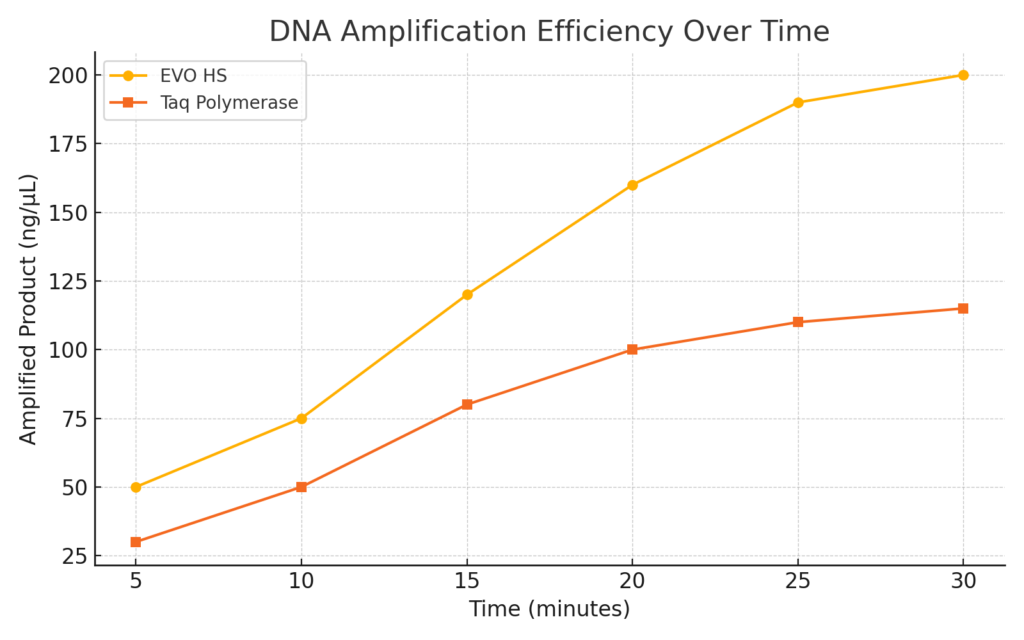
Unlike standard Taq polymerase, EVO HS incorporates proofreading activity (3’→5’ exonuclease) that significantly reduces the error rate during PCR. This feature makes it ideal for cloning, mutagenesis, and applications where accuracy matters—such as next-generation sequencing (NGS) library preparation and gene synthesis.

Why Fidelity Matters in DNA Amplification
Fidelity in PCR refers to the enzyme’s ability to replicate DNA without introducing errors. High-fidelity polymerases like EVO HS are engineered to maintain the correct nucleotide sequence, especially over long or complex templates.
According to NCBI, polymerase fidelity impacts everything from cloning outcomes to the reproducibility of genetic research.
For example, errors introduced during PCR may lead to incorrect conclusions in downstream experiments like CRISPR gene editing, protein expression studies, or phylogenetic analysis (NIH).
Technical Features of EVO HS Super-Fidelity DNA Polymerase
-
Ultra-high fidelity: More than 50× greater fidelity than Taq
-
Hot-start activation: Prevents non-specific amplification
-
Fast extension rate: Amplifies ~15–30 seconds per kb
-
Long-amplicon support: Works well with fragments >10 kb
-
Robust performance: Tolerant of GC-rich and complex templates
The enzyme is optimized for use in routine PCR, high-throughput applications, and experiments requiring precise variant detection.
According to Cold Spring Harbor Laboratory, high-fidelity enzymes are essential in applications where downstream sequencing or cloning demands absolute accuracy.
Ideal Use Cases in Laboratories
-
Gene cloning and expression
-
Mutagenesis experiments
-
NGS library amplification
-
SNP detection
-
Long-range PCR
The enzyme’s ability to handle high-complexity DNA without introducing errors makes it a go-to tool in academic, clinical, and biotech research labs.
Researchers at Stanford University and MIT often rely on super-fidelity enzymes in genome-scale experiments.

Humanizing the Technology
Although EVO HS is a laboratory-grade enzyme, its impact is ultimately human. Every experiment it powers might be a step toward understanding diseases, optimizing crops, or developing life-saving vaccines.
At UC Berkeley, students use similar enzymes in molecular genetics labs to learn hands-on techniques like PCR, gel electrophoresis, and DNA sequencing.
Furthermore, EVO HS’s reliability supports public-facing efforts like pathogen detection and environmental DNA (eDNA) studies, as done at the US Geological Survey (USGS).
Comparisons with Other Enzymes
| Feature | EVO HS | Taq Polymerase | Phusion® | Q5® |
|---|---|---|---|---|
| Fidelity | Ultra-high | Low | High | Ultra-high |
| Hot Start | Yes | Optional | Yes | Yes |
| Exonuclease | 3’→5’ | None | 3’→5’ | 3’→5’ |
| Extension Speed | Fast | Moderate | Fast | Moderate |
| Price | Moderate | Low | Moderate | High |
As noted by Cornell University, choosing the right polymerase is a balance between accuracy, speed, template complexity, and cost.
Reaction Setup and Optimization Tips
When using EVO HS, the following guidelines can help:
-
Annealing Temperature: Use gradient PCR or Tm calculators from university tools
-
Mg²⁺ Concentration: Optimal at 1.5–2.5 mM
-
Template Quality: Ensure high purity (check using NanoDrop methods)
Check guides from UCLA or University of Iowa for more in-depth PCR protocol recommendations.
A Look at the Broader Impact
EVO HS supports not just bench research but also outreach and training. Programs like NIH’s SEPA use accessible tools like this enzyme to teach genetics in classrooms.
Additionally, projects like DNA barcoding at the University of Florida rely on high-fidelity polymerases for environmental research and biodiversity tracking.
Researchers at USDA use such tools in plant and animal genomics to develop disease-resistant strains and improve agricultural productivity.
Conclusion
EVO HS Super-Fidelity DNA Polymerase is not just a technical upgrade—it’s a tool that enables scientific clarity. Whether used in classrooms, hospitals, or remote field labs, this enzyme brings accuracy and confidence to every amplified strand.
For those interested in learning more, Harvard University and Yale offer publicly available materials that explore PCR mechanisms and enzyme kinetics in depth.