
Understanding Protein A/G Magnetic Beads: A Tool for Gentle and Effective Antibody Capture
Protein A/G magnetic beads are a vital tool in biomedical research, especially when purifying or isolating antibodies from complex mixtures. These beads combine the antibody-binding properties of Protein A and Protein G, each derived from bacteria that naturally bind to immunoglobulins. By immobilizing these proteins on a magnetic bead surface, researchers gain a powerful tool for immunoprecipitation, protein purification, and other downstream analyses.
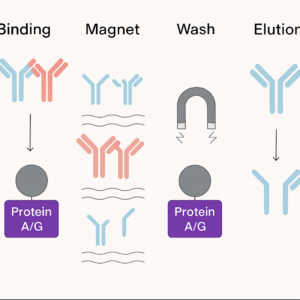
Unlike more complicated techniques, the concept is quite intuitive—tiny magnetic particles with special proteins on their surface latch onto antibodies, allowing them to be pulled out of solution using a magnet.

What Are Protein A and Protein G?
Protein A comes from Staphylococcus aureus, while Protein G originates from Streptococcus species. These proteins selectively bind to the Fc region of immunoglobulin G (IgG), a class of antibodies commonly found in blood.
-
Learn more about Fc receptors from NIAID/NIH.
-
The NIH’s PubChem entry on Protein A provides more technical details.
Protein A/G is a recombinant fusion of both, offering a broader range of IgG binding across different species. This is particularly useful in cross-species experiments or when the antibody is unknown.
Magnetic Bead Technology
Magnetic beads are tiny particles, usually made of iron oxide, coated with a polymer shell that allows for the attachment of biological molecules. When placed in a magnetic field, they quickly migrate, enabling fast and efficient separation.
-
A good primer on magnetic materials used in biotechnology can be found at MIT.
-
The National Nanotechnology Initiative (nano.gov) discusses how nanostructures enhance biomedical tools.
Why Use Protein A/G Magnetic Beads?
The fusion of Protein A and G on magnetic beads brings together the binding strength of Protein A and the versatility of Protein G, allowing researchers to work with antibodies from humans, mice, rats, goats, sheep, dogs, and rabbits.
Key benefits:
-
No centrifugation needed—just apply a magnet.
-
Mild and fast binding conditions.
-
Compatible with antibody pull-downs, chromatin immunoprecipitation (ChIP), and immune complex isolation.
You can find a basic explanation of immunoprecipitation at UCLA’s Biomedical Library.

Common Applications
1. Immunoprecipitation (IP)
Protein A/G magnetic beads are frequently used in IP assays, where they help isolate a specific antigen from a mixture using a target antibody.
-
Learn about IP protocols at Cornell University.
-
The NIH RePORTER system includes funded projects using magnetic beads for protein analysis.
2. Chromatin Immunoprecipitation (ChIP)
In epigenetic studies, researchers use Protein A/G magnetic beads to isolate DNA-protein complexes for downstream qPCR or sequencing.
-
Introduction to ChIP-seq at NCBI.
-
UCSC provides genome browser tools to visualize ChIP-seq results.
3. Antibody Purification
For small-scale antibody production, Protein A/G magnetic beads are used to purify antibodies directly from serum or culture supernatants.
-
The University of Michigan offers guides on affinity purification.
-
Details on antibody structure at NIH’s National Cancer Institute.
Limitations and Considerations
While versatile, Protein A/G magnetic beads are not universal. They don’t bind well to some subclasses of IgG, especially in species like guinea pigs or certain subclasses of rat IgG.
-
The Jackson ImmunoResearch guide at Upenn.edu outlines antibody compatibility.
-
NIST is working on standards for reproducibility in immunoassays.
Also, avoid harsh elution buffers unless necessary. Harsh conditions can denature proteins, affecting downstream applications.
Safety and Handling
While not toxic, the beads should be handled carefully to avoid aggregation and loss of magnetic properties. Avoid freeze-thaw cycles and always store according to the manufacturer’s instructions.
-
General lab safety protocols at University of Wisconsin–Madison.
-
Chemical handling guidelines from OSHA.
Final Thoughts
Protein A/G magnetic beads offer a simple, user-friendly, and highly effective method for isolating antibodies. With their unique ability to bind a wide range of IgG molecules and their fast separation via magnets, they’re a staple in biomedical, biochemical, and molecular biology labs around the world.
For those new to lab research, think of them like tiny fishing hooks. But instead of catching fish, they catch antibodies. And with a simple magnet, you reel them in.
-
Want to dive deeper? Explore the National Center for Biotechnology Information at ncbi.nlm.nih.gov.
-
For educational videos and webinars, check out NIH VideoCast.